About Me

My photo
I am working toward two masters degrees in Architecture and Integrated Building Delivery at the Illinois Institute of Technology. After a year of neglect, I hope this blog will help me document my working process, and I hope you enjoy checking out what I do.

Monday, March 19, 2012

So What IS this thing???

So after spending almost a month to research the neighborhood and define a basic program direction, we were faced with a horrifying assignment--all that stuff you just did, now make it into a building.  Yikes!  The jump from what you know, to what you want to do, to how you are going to do it is always a nervous endeavor.

For some reason you always feel compelled to have the right answer right away, and forget that it's all about iteration and process.  Of course, designers always forget this because we tend to throw out all the ideas that didn't work without recognizing that there are usually diamond-in-the-rough strokes of genius hidden in their implausible, uninformed, or ugly exteriors.

The following images document the sting of head-scratcher moments I had in developing my program and building into a project with an attitude and an objective.

It's always easier to start with what you know, even if that is nothing.

My first piece of clarity.  And therefore my first assertion.
As a distribution-centric project, what goes in and what goes out is an important aspect to define.  The social hub pulls people in, and the commercial network ensures that growth perpetuates within the community.  Without both, community development is unsustainable.  To tie in greater ideas of sustainability, this attitude was expanded; the project should soak up local resources--in the form of labor, recycled building materials, expertise, drive, and culture. 


Sponges soak up everything around them.
So do roots.


Soaking up resources also extends to the idea of passive energy strategies.  Sculpting the building geometry to make the best use of available daylighting and natrual ventilation harnesses the resources around the building rather than piping in energy sources from remote sites.

Removing materials from the waste stream is a key aspect of sustainable building in my opinion.  Too often we focus only on passive lighting and cooling/heating strategies, which is great, but the "greenest" construction is no construction.  Therefore, I am aiming to reuse building materials when possible.

I produced a conceptual statement for sustainable strategies that were in keeping with the idea of the idea of soaking up resources without simply tacking something onto the side or top of the building.  Highlighted here are rainwater catchment, solar mass heating (could also be PV/solar power), and geo-exchange passive heating/cooling. 
A conceptual statement about sustainability.
At the same time, we had to choose which of the two sites we wanted for our projects.  Though they are basically in the same location, they differ both in size/scale and orientation.
Each student had a choice of one of two sites to locate their projects.
In analyzing the two sites, I was initially discouraged by the smaller size of Site 1.  However, Site 1 had a clear advantage in that the building orientation that would facilitate passive daylighting would also allow a higher transparency in the building on the 43rd St. frontage.
Site analysis comparing views and access with daylighting, shading, and wind direction.
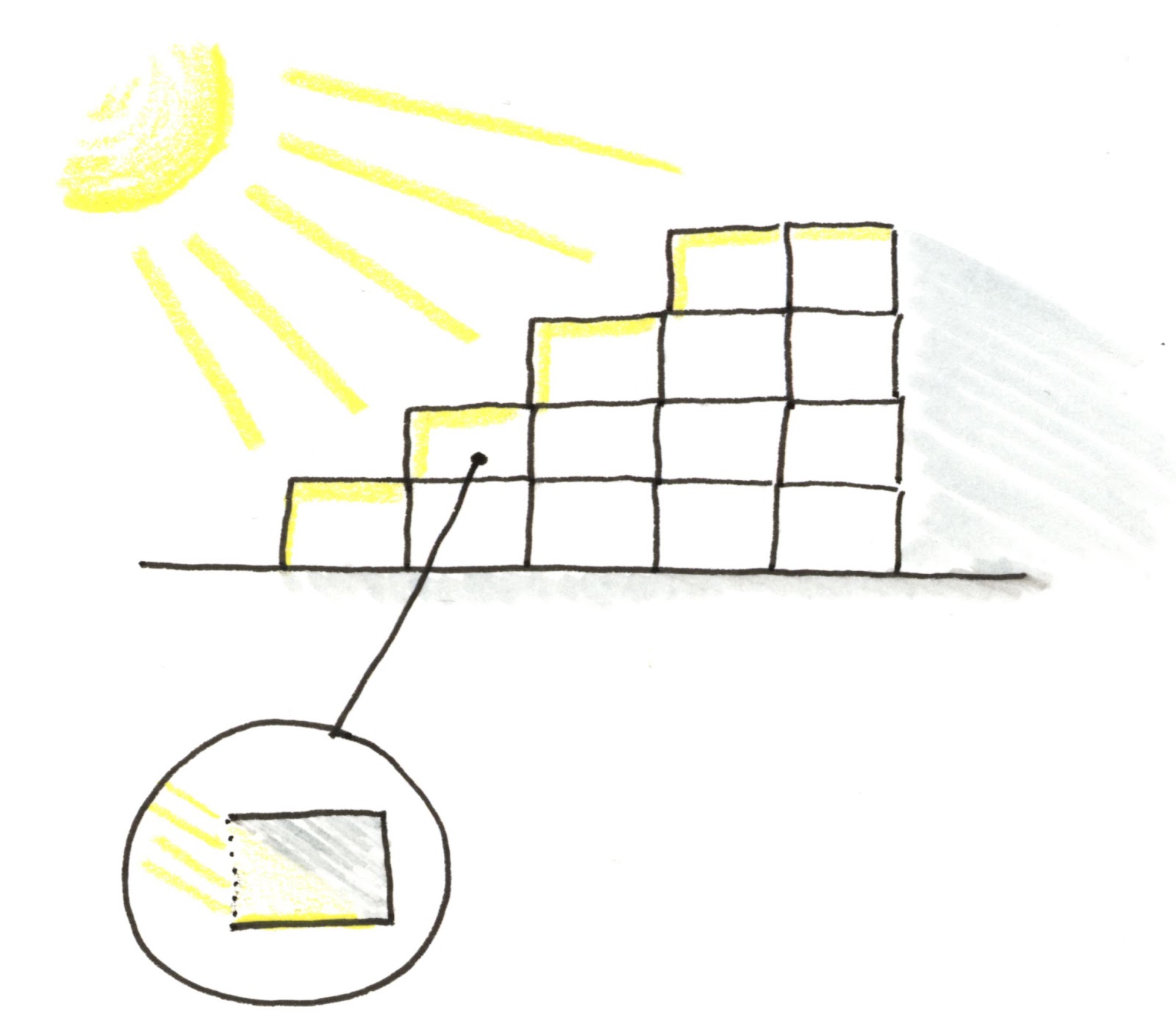
Despite my initial hesitance with Site 1, its more compact and urban attitude fit in nicely with my concept of using and wasting less, and I was happy with my decision.  Having chosen my site, I then used the solar geometry to try to intuit a basic building geometry/setback.
Stepping East to West will create the least amount of shading on the site.

But what goes into the building is not the whole story; just as important is the ability for the center to generate goods, services, and knowledge that can go into the community.  In conceptualizing this, the image of the dandelion came to mind.  The plant produces seeds like any other, but its progeny is spread in a very distributive and mobile manner.

Taken the the natural conclusion, this idea of progeny could suggest a physical means to have the center grow and expand, planting the seeds for future projects where they are next needed most.  (Disclaimer: the following two images are not my own.)


Seed/spore (re-)generational growth model.


It definitely helped me to start thinking of my educational component in terms of both a filling up (sponge concept) and a flowing out (seed concept).  The program would attract local or regional talent for teaching as well as underemployed or homeless residents as students.
The basic education program would then filter through the rest of the program, offering students experience in both restaurant and catering kitchens as well as experience on the ground assisting in distribution and outreach endeavors.  In this way, those who receive are always giving back.  From there, graduates can either find job placement or continue their education to prepare to open up their own businesses, hopefully rooted in Bronzeville.


By the end of this conceptualization, the ideas of diverting building materials from the waste stream, of modular and generative growth, and of distribution and mobility coalesced into one conceptual unit: the ISO standard shipping container.

More to come!

Food Access Case Study: DC Central Kitchen

At the beginning of the semester, we were each assigned a food access case study, and I serendipitously chose the DC Central Kitchen (DCCK), as it highly informed my programmatic development.

The DCCK is a 23-year-old anti-hunger organization primarily serving the homeless population of the DC area, providing breakfast, outreach, & counseling services to chronically homeless people living on the streets.

"Our mission is to use food as a tool to strengthen bodies, empower minds, and build communities. Our programs provide a comprehensive continuum of care to the people we serve.”


DCCK brings in about 3000-4000 lbs of unused food daily from hospitals, hotels, restaurants that would be thrown away.  Additionally, the organization purchases fresh produce in bulk from local farmers, freezing the surplus for year-round use.  DCCK prepares 4000-4500 meals per day, 365 days a year, and distributes it to 100 shelters, transitional homes, and rehab clinics throughout the DC area.  Facilities have to be equipped for multiple deliveries, bulk storage and freezing, and a full-service kitchen.
 

DCCK's new 6000 sf space, called the "Nutrition Lab" includes not only kitchen and production spaces but also additional office space to administer new programs that meet the nonprofit's mission of bringing jobs and meals to the people and communities who need them the most.


DCCK's Culinary Job Training Program
  • Offers nationally recognized culinary job training to once homeless and hungry adults.
  • Graduates of the 16-week professional training program receive a certificate.
  • Employs graduates in full-service catering company or places them in full-time jobs at restaurants and hotels in the area.
DCCK prepares students for job placement with resume-building workshops and other services in their offices and computer labs.


Fresh Start offers full-service catering and dining services as a revenue-generating social enterprise and provides transitional employment opportunities for culinary program graduates.
Healthy Corners brings fresh produce from local farmers to corner stores in areas without access to healthy food choices.


To find out more information about the DC Central Kitchen, check out their website: www.dccentralkitchen.org


After researching this organization, I decided to look into what services were already present in the area to address the local homeless population.  In doing so, I was able to find a map of the area with services shown.


Near to the site we are working in, the following resources are available:
With so many resources nearby, it seems viable to try to partner with these institutions for food preparation and delivery.  The DCCK is so pertinent to my developing program because it exemplifies a distribution-centric food access project.  In my demographics research, I found in the 2010 US Census that nearly 5% of the population in the 60653 zip code surrounding the site is homeless or institutionalized.  I want to be able to reach and provide for these people in my project.

For more information on homelessness in Chicago, visit the following:
Chicago Alliance to End Homelessness
Homelessness in Chicago Report: 2007 Numbers and Demographics
Mapping Project: Services and Resources for Homeless in Chicago Area
Chicago Coalition for the Homeless 


Saturday, March 17, 2012

Get with the PROGRAM!

As mentioned, my next post will be dedicated to the development of program for the current project.  At first the class decided upon a "backbone" of sorts, a generic program that stipulated food access in the form of retail opportunities and restaurants, business incubation in the form of rentable kitchens, an educational component with necessary admin, community spaces such as meeting/eating spots and event spaces, and finally, support for students and employees, including child care and technology access.  At this point, we were instructed to anticipate an "OTHER" in our program as something non-related to accompany the backbone program.  In personalizing the programs, we could make them more rich and interesting.

From there, the class broke down into smaller groups focusing on one of three foci in an elaborated program:
  • education or incubation emphasis
  • distribution emphasis
  • food growth/aquaponics emphasis
In the distribution emphasis group, we developed 4 program varieties that could be used to inform other groups' programs if they were interested in incorporating distribution models, and others that focused on distribution as either an on-site or off-site idea.  Here is a condensed look at them:
We analyzed the appropriate placing of each piece of program on the site in all 3 dimensions as well as how the building entries should respond to the surrounding site.
 Following this blog, I will start posting drawings from my sketchbook that helped me figure out my individual program and how to respond to the site.

Reassemble the troops!

It is completely embarrassing that I have neglected this blog pretty much as soon as I started school (that might be an indication of how much work I have in school!).

This post is a warning to look out for posts soon (hopefully later today).  I will try my best to compile an archive of projects from my first year and a half in school, but will be focusing heavily on my current project, which is a response to the food desert condition in the Bronzeville neighborhood in Chicago.  As Wikipedia quotes:
A food desert is any area in the industrialized world where healthy, affordable food is difficult to obtain. Food deserts are prevalent in rural as well as urban areas and are most prevalent in low-socioeconomic minority communities. They are associated with a variety of diet-related health problems. Food deserts are also linked with supermarket shortage.
The course is run by Professor Monica Chada, who is investing multiple semesters and student bodies in the Bronzeville area.  Ours is the second class to focus on bettering the area.  In addition to addressing the food desert situation, our projects are intended to integrate business incubation, to further improve the community through commerce.

I was responsible for researching the demographics of this area at the beginning of the semester, and I will share a bit of that information here:

Bronzeville area, with 60653 demographics area shaded and a star marking the site.


*Disclaimer: all images of my own making.  (Sorry they do not translate well to this format.)

For this project, we are assembling a book of research and project development that will eventually be available to members of the community.  Research was done in the history, climate, and area amenities (or lack there of) by my classmates.  I might look into posting some of their work at a later date. 

After our research, the class was responsible for defining a basic program from which to work, then refining that basic program to generate individual responses to the situation.

NEXT UP - PROGRAM!

Saturday, August 21, 2010

New Blog!

Hello, friends and followers.  You are receiving this email because I added you to the email list from my blog.  Every time I post something, it will go to your email like this one just did.  I did not know how to do this before I posted my last blog about orientation week, so this is also an announcement that that post is up!

Some of you might also be "following" my blog, and others might just find this to be annoying.  Please let me know if you would rather be taken off of the list, either by commenting this blog post or contacting me in some other way.  I will not mind, and if you really do not want to be on the list, it will allow someone else to be on it who does.  LOL.

I kept this list to just those who were already following (minus a few with work emails), people who had expressed interest in my blog, or certain family members who might not be able to remember my blog if I do not pester them (just kidding).

If you have come across this blog/post and are not on the list, I can add you, so long as there are enough 'slots'... for some reason they only allow 10 people to be listed.

Enjoy your weekend!
-xopher

Orientation Week

Made it through the 3-day orientation process this week, and already I'm tired.  Partially because the first two days I biked to school, which is a 10.2 mile commute each way, each day.  Thank goodness I will be getting my Upass next week!  (Although, I will miss the beautiful route of the lakeshore path.)

I just wanted to share a few pix I snapped from campus; I am so excited to be studying architecture at a campus so rich in architecturally significant buildings.  The first building I encountered for orientation was the McCormick Tribune student center by Rem Koolhaas.  It is definitely a building you want to explore.
Student Center, West Entrance
The West facade of the building has an angular undulation to it, and is filled with a vivid orange translucent material.  A flooding orange glow permeates the circulation spaces on this side of the building.  I entered the building from the South entrance, and walked toward this area; the experience was pretty fascinating. The doors themselves make up part of the Mies 'mural' -- it is made up of an arrangement of little stick-figure images that work like a photomosiac. 

The building sits under the green line tracks like a hot dog bun opened up on a plate.  The tracks were incorporated into the architecture by a tubular envelope shielding the train noise (mostly) from the building's interior.  Here you can see the tunnel:
CTA "El" Tunnel. 
As you can see, the tunnel is pretty beefy and dominating visually. From street level, it looks like it completely envelops the train, but the "top" of the tube is mostly open, with only rib-like arched supports making the full turn.

The space inside the building emphasizes a flat, even vertically compressed environment.  The 'underbelly' of the train tube is accommodated by a linear drop in ceiling height through the building that looks like a section of the ceiling has literally been pushed downward into the space.  Under that, a computer station "trough"cuts into the floor plan like a rectilinear riverbed.
Interior Courtyard or Hanging Gardens?

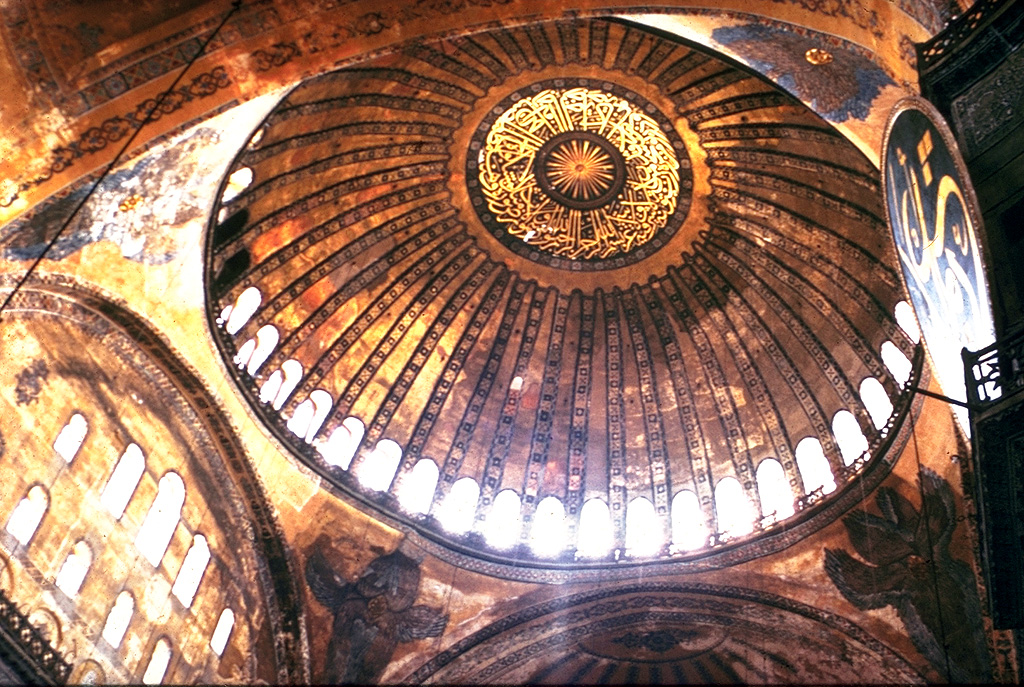
The plan wraps around a courtyard-like enclosure that is open to the sun and filled with vegetation.  This brings a great deal of light to the space and frees it from feeling compressed.  To the side of the courtyard, the floor level drops in stages to create an informal amphitheater.  The hollowed space continues under the courtyard, and to the other side, providing dining services.  The way the "lower level" is dug out from under the courtyard space makes it look like it is floating, like a modern "hanging garden".  It's a great effect, one that reminds me of how the halo of light makes the mammoth dome of Hagia Sophia seem like it is nearly floating overhead [shown below]. 
Dome of Hagia Sophia (Image from Columbia.edu)
And speaking of flooding light... this will be my studio space for the next year:
Northwest corner of Crown Hall, Architecture Studios
Don't you wish your office looked like this?  It is a beautifully simple and unobtrusive space.  Again, I am very excited to be working here, but I am also a little nervous about all the work that will be involved.

That is it for now.  I will try to keep my posts shorter in the future.  Stay tuned!

Monday, August 2, 2010

About the title and my program of study

I am lovingly calling this blog "architorture" in homage to the nickname given to the undergraduate architecture program at Washington University in St. Louis.  I graduated from that university with a double-major Bachelors of Fine Arts in Sculpture and Film/Media Studies.  This last Spring, I also graduated from Harrington College of Design with an Associates of Applied Sciences in Interior Design.

I am very anxious and excited to start the Masters in Architecture program at the end of August.  Their program was founded by Mies van der Rohe in an attempt to make the "American Bauhaus" after fleeing from Nazi Germany.  It's nice to feel part of a tradition such as this.  Our main building is Crown Hall, a smart and simple building with grand uninterrupted space inside flooded with natural light.  (For more information, visit http://www.iit.edu/arch/crown_hall/ )

In keeping with the "architorture" theme, I just bought Physics for Dummies and Calculus for Dummies.  Since I have not used or studied either for years now, it is a must for me.

Wish me luck!